
Capital: Kibi
Location: it lies within longitude 0º.56 West and 0º. 15 West and latitude 6.03 North and 6º•.35 North
Land Area: total land area of approximately 725km2
Boundaries: It is bordered by Kwahu South District to the North, Atiwa District to the North West, Kwabibirem District to the South West; Fanteakwa to the East and New Juabeng and Suhum-Kraboa-Coaltar Districts to the South.
Relief and Drainage:
The land is generally undulating and rises about 240 metres to 300 metres above sea level with the highest point being the Atiwa ranges rising over 350 metres above sea level. There are several different types of rock formation giving the different relief features ranging from flat bottom valleys to steep-sided highlands which are usually covered with iron pans, bauxite and kaolin. The underlying rocks are of the Birimmian formation covering over three-fourths of the closed forest zone. Also found are masses of granite which occur in parallel belts. This rock group contains several mineral deposits including gold, diamond, bauxite and kaolin.
The municipality is drained by rivers such as the Birim, Pra, Densu, Kua, Adenchensu and Merepong most of which have their catchment areas within the Atiwa and Apedwa Forest ranges. Several other seasonal streams are found in the municipality. The pattern is largely dendritic flowing in the north-south direction.
Climate :
The municipality lies in the west semi-equatorial zone characterized by double rainfall maxima occurring in June and October; the first rainy season from March to June and the second from September to December. The mean annual rainfall is between 1250mm and 1750mm.
Temperature is found to be fairly uniform ranging between 26oC in August and 30oC in March. Relative humidity is generally high throughout the year, ranging between 70% – 80% in the dry season and 75% – 80% in the wet season.
Vegetation:
The municipality lies within the moist semi-deciduous forest. There are few forest reserves covering about 108.8sq. km, including part of the Atiwa Forest Reserve. The forest reserves constitute about 15% of the entire surface area of the muncipality. Some commercial species of trees found in the forest are Odum, Wawa, Ofram, Mahogany, Kyenkyen etc.
Soil:
The major soils in the municipality are the Asikuma-Atiwa-Ansum/Oda Compound Association. Dominating this soil group is the Atiwa series which are mainly red, well drained, deep gravel-free silty loams and silty- clay loams. The Peki series are brown to reddish yellow, moderately well drained, very shallow and rocky. The valley bottoms are occupied by the Oda series which are poorly drained alluvial silty clays.
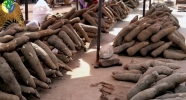
The soils are suitable for the cultivation of both food crops (cassava, plantain, yam, cocoyam, maize) and cash crops (cocoa, coffee, oil palm, citrus, cola) which are grown in the municipality.
Table 1.0 Soil Classification and their Suitability
| Soil Classification | Characteristics | Soil Capability |
| Kumasi-Asuasi/Nta Ofin Nsaba-Swedru/Nta-Ofin and bekwai-Nzima/Oda soil Associations | - Greyish brown loamy soils overlying red clay soils at lower elevations of slopping hills
- Grey alluvial sands of thin layers |
Cash crops (cocoa, coffee, rubber, oil palm), maize, cassava, plantain, cocoyam, dry season vegetable, pepper, soybean, sugar cane, sweet potato, rice |
| Atiwa-Ansum, Adawso-Bawjiasi/Nta-Ofin, Atewiredu-Katie and Atukrom-Asikuma/Ansum soil Associations | Reddish brown, deeply weathered sedentary soil. Usually found on upper slopes and summits. Very deep and well drained, very poor moisture retention during dry seasons. Top soil is easily eroded. | Suitable for hand cultivation of coffee, cocoa, cocoyam, plantain, maize |
| Yaya-Bediesi/Bejua, Nyanao-Tinkong/Opimo and Pimpimso-Sutawa/Bejua soil Associations | Yellowish red, gravely soil with moderately shallow depths. | Best suited for wildlife conservation, forest reserve and watershed protection purposes. If it should be used for cultivation then it should be done using appropriate cultural practices. |
| Chichiwere-Ayensu/Kakum and Amo-Tefle soil Associations | Deep brown to greyish brown, moderately well drained sandy loam to clay within rarely flooded bottoms of valleys. | Suitable for the cultivation of maize and vegetables like pepper, tomatoes, onions, and garden eggs. |
| Pegu-Agu, Adunjansu-Bechem/Nta-Ofin and Koforidua-Nankese/Nta-Ofin soil Associations | Moderately to well drained soils found both on uplands and on lowlands | Uplands: Cocoa, coffee, maize and cassava.
Lowlands: sugar cane and vegetables |
NATURAL RESOURCES
The municipality has a fairly large land mass of which cultivable area is 435km2 representing 60%.
The Municipality abound in mainly mineral and forest products as well as water bodies. Mineral resources include deposits of gold, diamond, bauxite and kaolin. The gold and diamond deposits are found in the Birim river basin, Asikam, Abekoase, Agyapoma, Enyiresi, Abreponso, Kwabeng and Kibi. Kaolin deposits are found at the Atiwa Ranges whilst bauxite and manganese are found in Asamama and Apapam.
The forest reserves are found at Atiwa (158 sq.miles.) and Apedwa (25 sq.miles.)
The rivers and streams are potential resource base for fishing and small scale irrigation schemes. The municipality is also rich in ground water resources as a result of light rainfall and underlying rock formation in the region. This is a potential source for bore-hole water.
AGRICULTURE
Approximately 60% of the municipal labour force is engaged in agriculture.
The table below depicts the occupational structure of the municipality which involves all the major economic activities of the country.
Table 2.0 Occupational Structure
| Category | Percentage of Population |
| Agriculture | 58 |
| Service | 21.5 |
| Commerce | 11 |
| Industry | 9.5 |
| Total | 100 |
Source: DPCU, Kibi
Agriculture is practiced at the subsistent level by 62% of the population with the remaining 38% involved in some form of large scale agriculture.
Land holdings for agricultural purposes in the municipality are done through permanent ownership (family inheritance, outright purchases) and leasing arrangement (Abunu & Abusa)
Majority of the farm lands are held through the Abunu and Abusa land leasing arrangements
The average land holding size for agricultural is 0.1-2ha with a farm family size of 6.
CROP CULTIVATION
The municipality grows both food & cash crops.
Table 4 & 5 shows the major crops grown and their output alongside their acreages (i.e. hectares) and their areas of concentration in the municipality.
Table 3: Output/ Cropped Area for Major Crops in the Municipality
| Crop | Avg. Farm Size(in hectares) | Municipal Output (in metric tonnes) | Area under cultivation (Ha) |
| Yam | 0.25 | 4,130.0 | 295.0 |
| Plantain | 0.8 | 53,731.4 | 5,069.0 |
| Cassava | 0.8 | 92,260.0 | 6,590.0 |
| Maize | 0.8 | 11,132.1 | 5,859.0 |
| Cocoyam | 0.25 | 15,568.8 | 1,497.0 |
| Rice | 0.8 | 12.8 | 8.0 |
| Citrus | 0.5 | - | - |
| Oil Palm | 2 | - | - |
| Cocoa | 2 | - | - |
2010 Production Levels
Table 4: Major Food/Tree Crops and Their Areas of Production
| MAJOR FOOD/TREE CROP | MAJOR AREAS OF PRODUCTION |
| Rice | Osiem, Bunso |
| Plantain | All over the municipal |
| Cassava | All over the municipal |
| Maize | All over the municipal |
| Garden eggs | Nobi, Apedwa, Kukurantumi, New Tafo, Bunso, Maase |
| Pepper | Nobi, Asafo, Kukurantumi, Sokodojuaso |
| Citrus | Osiem, Bunso, Asiakwa, Ethokorum |
| Cocoa | All over the municipal |
| Oil palm | Addokwanta, Ayinasin, Maase, Nobi, Bunso |
Some small scale irrigation farming is practised along the banks of the Birim River and its tributaries, especially for the cultivation of vegetables.
Animal rearing in the municipality is generally at the subsistent level with most reared domestically. These include cattle, sheep, goat, rabbit and poultry.
Table 5 gives details of the types of animal reared in the municipality.
Table 5: Type and Number of Animals/Birds Reared
| No. | Animal | Avg. Flock | No. Reared |
| 1 | Cattle | 4 | 459 |
| 4 | Sheep | 4 | 5,980 |
| 5 | Goat | 5 | 20,000 |
| 6 | Rabbit | 10 | 602 |
| 7 | Local fowl | 8 | 48,200 |
| 8 | Exotic fowl | 150 | 14,500 |
| 9 | Ducks | 5 | 632 |
| 10 | Turkeys | 3 | 302 |
| 11 | Guinea fowl | 2 | 152 |
| 12 | Pigs | 6 | 1,416 |
2010 Figures
| MARKET CENTRES | MAIN FOOD ITEMS |
| Kibi | Plantain, Cocoyam, Maize, G. eggs, Okro, Pepper, Palm oil, Palm fruits. meat, cassava etc. |
| New Tafo | Plantain, Cocoyam, Maize, G. eggs, Okro, Pepper, Palm oil, Palm fruits. meat, cassava etc. |
| Asafo | Plantain, Cocoyam, Maize, G. eggs, Okro, Pepper, Palm oil, Palm fruits, cassava meat etc. |
| Asiakwa | Plantain, Cocoyam, Maize, G. eggs, Okro, Pepper, Palm oil, Palm fruits. meat, cassava |
ii) AGRICULTURAL INSTITUTIONS IN THE MUNICIPALITY
a) Cocoa Research Institute of Ghana (CRIG)
b) Plant Genetic Resource Research Institute of CSIR
c) Bunso Cocoa College-Bunso
d) Dist. Cocoa Swollen Shoot & Virus Disease Control Unit
e) Dist. Seed Production Unit of COCOBOD
