


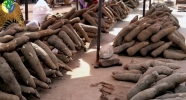
Agriculture
Crop Farming
Farms in the Municipality are, on the average, small in sizes and farm holdings are scattered. The average farm size per farmer is about 0.4 hectare. Agricultural production is near subsistence with very few of the farmers engaged in plantation farming. Majority of the farmers are involved in crop farming and the main crops cultivated are:
Starchy, Staples Like Cassava, Cocoyam, and Plantain,
Vegetables like Tomatoes, Okro, Garden Eggs, Pepper, and Cabbage.
Tree crops like Oil Palm, Cocoa, and Citrus
Cereals like Maize and Rice.
Land Tenure System:
Rent or hiring from landowners (lease);
Mortgage
Stool lands or inheritance from family
Shared cropping (abunu and abusa)
Plots and Farm Sizes
A feature identified in the Municipality during the baseline survey was the multiplicity of plots of land per farmer. These plots of land, all small in size, were scattered over the area, often at considerable distance from one another. A greater percentage of the farmers have 2 or more farm plots with farm sizes ranging between 0.4 -5 hectares.
Such distribution of farm holdings in different places means farmers do not practice block farming. The small farm size constitutes a remarkable barrier to agriculture and makes efficient production difficult, as it does not encourage the establishment and maintenance of economic layout. Variation in the size of farms occupied by individual families at different stages in their life is also not provided like mechanization, irrigation, etc on farms, which are small in size.
Types of Crops Cultivated
Crop production is mainly traditional and generally near subsistence level as majority of the farmers do not have access to machinery for farming. Maize is planted twice during the year, that is, during the major and minor seasons. Major crops produced in the area are shown in the table below:
MAJOR CROPS AND THEIR PRODUCTION AREAS
| CROP TYPE | AREAS MOSTLY GROWN |
| Cocoa | Produced throughout the Municipality |
| Oil Palm | Asanteman, Manso, Batabi |
| Citrus | Manso, Asanteman |
| Rice | Oda Nkwanta, Nyame Nti |
| Maize | Produced throughout the Municipality |
| Cassava | Asubua, Akroso, Otaipro |
| Pepper | Asene, Batabi, Mante |
| Garden Eggs | Asene, Akroso, Batabi, Mante |
| Plantain | Produced throughout the Municipality |
| Cocoyam | Asuboa, Manso,Moffram |
A greater percentage of the maize cultivated are harvested when dry, stored in cribs and barns and disposed off in the lean season. The greater part of the maize cultivated is consumed with a little going for the preparation of animal feed.
PRODUCTION FIGURES OF CULTIVATED CROPS
| CROP | ESTIMATED HOLDERS FOR THE MUNICIPALITY | AV AREA CROPPED/HOLDER | TOTAL AREA CULTIVATED (HA) | YLD/HA (MT/HA) | TOTAL ESTIMATED PRODUCTION (MT) |
| Maize | 27,480 | 0.43 | 11,816.4 | 2.49 | 29,422.04 |
| Rice | 302.00 | 0.48 | 144.96 | 2.67 | 387.04 |
| Cassava | 30,686.00 | 0.42 | 12,888.12 | 10.72 | 138,160.65 |
| Cocoyam | 23,517.00 | 0.18 | 4,233.06 | 9.78 | 41,399.33 |
| Yam | 503.00 | 0.32 | 160.96 | 11.38 | 1,831.72 |
| Plantain | 22,981.00 | 0.27 | 6,204.87 | 12.56 | 77,933.18 |
| Pepper | 2,680.00 | 0.75 | 2,610.00 | 2.22 | 2,391.90 |
| Tomato | 402.00 | 0.32 | 128.64 | 1.19 | 285.85 |
| Citrus | 1,139.00 | 2.37 | 2,699.43 | 53.05 | 143,181.95 |
| Oil palm | 4,828 | 2.11 | 10,187.08 | 20.24 | 206,186.50 |
Farm tools
farm implements used are cutlasses, hoes, axes, mattocks, and equipment like spraying machines and prunes. The use of modern agricultural technologies is very limited. Traditional practices such as, slash and burn etc. are still widespread.
Farm Labour
Considering the simple farm tools in use, there is the need for a high degree of manpower. The average age of the farmers ranges between 40 and 72 years.
Farming in the area is, therefore, undertaken by the old people who do not have the necessary energy to work and manage the farms. They depend heavily on household and hired labour. Hired labour is, however, scarce and expensive. Farmers use a combination of household, hired and co-operative labour. The use of hired labour is evident during the peak labour period, especially during land clearing and weeding.
Labour cost is high for most farmers, above their limited resources. As a result of limited financial resources, the farms are not properly maintained and these, in the long run, affect output.
Application of Seeds and Agro-Chemicals
The farmers use two types of seeds. These are local seeds and improved seeds. These seeds are acquired from three main sources, namely, from previous crop harvest, private traders and the Ministry of Food and Agriculture.
The use of organic manure, chemical fertilizers and other agro-chemicals is on a limited scale though increasing steadily. In the use of fertilizers, for example, over 50% of the farmers do not apply any kind of fertilizers. The types of fertilizers, applied are compound fertilizers (15:15:15) and Sulphate of Ammonia
On the use of agro-chemical, few of the farmers apply herbicides (weed killers) pesticides and fungicides. The limited use of agro-chemicals and improved seeds is one of the major causes of low agricultural productivity in the Municipality.
Farm Finance
The principal source of funding for farming activities is from the farmers’ own savings. Other sources are private money lenders, relatives and a limited percentage from the banks.
The role of existing financial institutions and other sources of acquiring credit are minimal though increasing steadily. The limited number of credit facilities is due to the cumbersome procedures and the lack of collateral demanded by the banks and the mistrust generated by the failure of some farmers to pay back loans earlier taken. Few farmers in the Municipality, therefore, benefit from credit facilities as most of the farmers cannot meet the requirements for obtaining loans. There is a strong desire among farmers to have access to credit facilities from sources other than money lenders as the interest rate charged by money lenders are extremely high. Indeed the minimal use of farmers’ associations in the Municipality makes it difficult for farmers to mobilize credit.
Storage facilities
Modern storage facilities such as silos, warehousing with dry facilities, etc, are not in existence in the Municipalityity. The main types of storage facilities in use are the traditional barns, a few improved cribs and roof storage.
Maize is the only grain with an elaborate storage system. Facilities for the storage of other farm products are not available resulting in high post harvest losses. Processing as a means of conserving output is at a very low level and the traditional methods use are not efficient. These compel the farmers to sell their farm produce at low prices during the harvest.
Marketing System
Urban-based middlemen within and outside the Municipality undertake marketing of farm produce. Most of the farmers sell their produce at the nearest local market to these middlemen who in turn send them to other marketing centers especially the Oda market for sale. The use of middle men in marketing agricultural produce is unfavorable to the farmers. Prices of farm produce are therefore, very low especially during harvest time when there is a glut and this serves as disincentive to the farmers. The poor roads to farming areas lead to limited access to the bigger markets, which can offer better price for their crops.
Problems and Constraints
The main problems facing crop farming are
Animal Production
Most of the farmers engaged in crop farming also keep livestock. The types of animals reared include sheep, goats, pigs, cattle and poultry. These are reared as supplementary activities to meet part of their protein requirements and also to earn additional income. The animals reared are kept in stys, pens and hen coops. The goats, sheep and pigs are fed through the free grazing method that is grazing on the open vegetation, while the others especially poultry are fed tin enclosed areas. Animal disease is an area of great concern, these include endo-parasites, ecto-parasites, PPR, Gumboro, Newcastle and coccidiossis. Veterinary Services is offered by the Ministry of Food and Agriculture in the Municipality.
Marketing/Services Sector
The Municipality has 15 daily markets and 8 periodic markets that are geographically distributed in the Municipality.
| Market | Market days | Main food items |
| Akim Oda | Mondays and Thursday | Cereals, root and tubers, plantain, oil palm, fish and meat |
| Akim Akroso | Tuesday and Friday | Cereals, root and tubers, plantain, oil palm, fish and meat, gari |
Major markets and their market days are shown in the table below
The biggest of these markets is the Akim Oda market. It covers an area of 1.3 hectares.
The area of influence of the market includes the Eastern, Brong Ahafo, Ashanti, and Greater Accra Regions. Major items found on this market includeagricultural and industrial produce.
AGRICULTURAL PROJECTS
There are several agricultural interventions in the form of projects to assist farmers increase their production and subsequently their income. Two of such projects are the Inland Valley Rice Project and the Root and Tuber Improved Marketing Project (RTIMP).
Table below shows a summary of the Inland Valley Rice Development Project for 2010
| Project
Site |
Target
(Ha) |
Area
Cultivated |
Yield
(84kgbag) |
Yield
(Mt/ha) |
Benefeciaries | |||
| male | female | |||||||
| Oda Nkwanta | 20.0 | 16.4 | 547 | 2.8 | 15 | 3 | ||
Root and Tuber Improved Marketing Project.(RTIMP)
The project has constructed a Good Practice Center at Otaipro for the processing of gari.Two groups of processors made up of 38 females and 12 males work at the center. Some of the improved varieties of cassava grown in the Municipality are Apranifi, Bankye haa,and Tech bankye and they have an average production of 12tonnes/acre
Agricultural Extension Services
The main aim of the MOFA Extension Service in the Municipality is to address the felt needs of the farmers and also to assist them to increase agricultural production through the transfer of improved production and post production technologies that would support better living standards. This is normally done through home and farm visits as well as demonstrations. About 68% of farmers have access to extension services. The Municipality is divided into four (4) sub -Zones namely: Akim Oda, Akim Manso, Akim Asuoso, and Akroso
Each sub-Municipality is manned by Municipal Agricultural Officer (MAO). The sub-Zones are also divided into operational areas, which are also manned by Agriculture Extension Agents (AEAs). Hence the average of AEA to farmer ratio in the Municipality is 1:1600.
ZONING OF THE MUNICIPALITY FOR AGRIC MANAGEMENT
| SUB MUNICIPALITY | OPERATIONAL AREA |
| 1. AKIM ODA |
|
| 2. AKIM MANSO |
|
| 3. AKIM ASUOSO |
|
| 4. AKROSO |
|
| FBO
1. CITRUS GROWERS AND MARKETING ASSOCIATION 2. IDEAL WOMEN’S GROUP 5. BIAKOYE CASSAVA PROCESSING GROUP 7. MANSO WOMEN OIL PALM PROCESSING GROUP 9. GREENLEAF OF HOPE FARMERS 13. TEACHER ATTA CASSAVA PROCESSING GROUP 14. SUPPONSO CASSAVA PROCESSING GROUP 15. UNITY RICE FARMERS ASSOCIATION |
LOCATION
AKIM ODA ASUBOA OTAIPRO-AKROSO AKIM MANSO BANTAMA TEACHER ATTA SUPONSO ODA-NKWANTA |
REMARKS
SALE OF CITRUS OIL PALM PROCESSING CASSAVA PROCESSING OIL PALM PROCESSING GROW VEGETABLES AND PLANT TREES CASSAVA PROCESSING CASSAVA PROCESSING RICE PRODUCTION |